 TRAIL Lab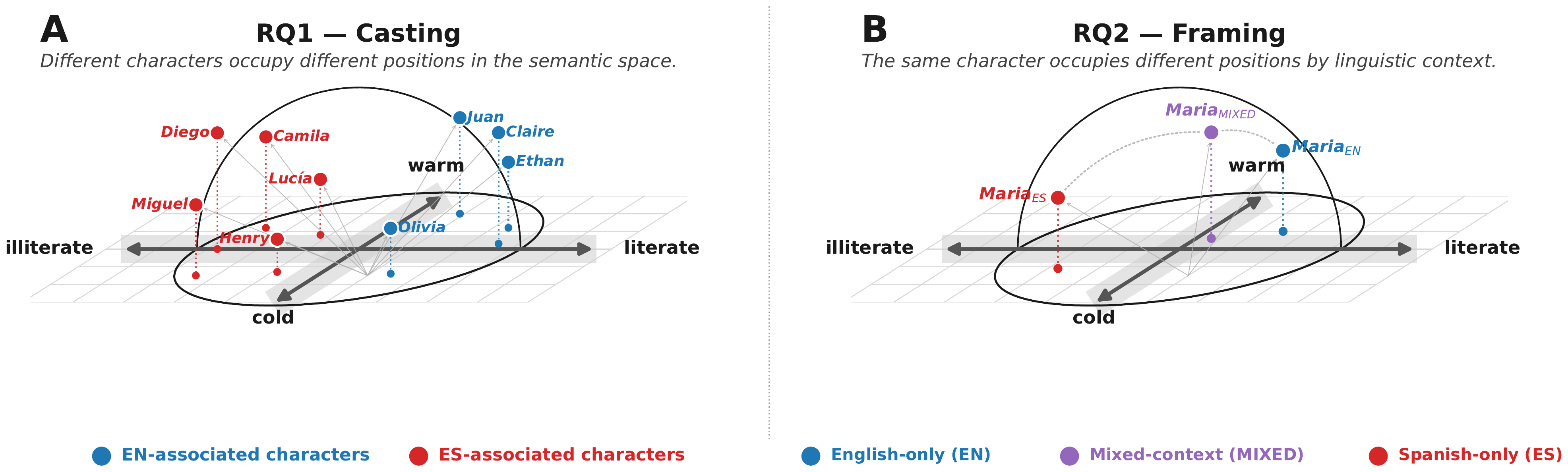
Abstract
Bilingual young adult (YA) literature shapes how Latine youth understand language, culture, and identity, while also serving as training data for large language models. This dual role raises questions about what semantic associations bilingual fiction encodes, and how these associations vary across linguistic contexts. We present a socio-technical audit of character representation in 70 Spanish–English YA novels. Using contextual embeddings from XLM-RoBERTa and 25 interpretable semantic axes, we analyze 619 character names across English-only, Spanish-only, and Mixed language contexts. Our framework separates casting (which characters are associated with which linguistic contexts) from framing (how the same character’s portrayal shifts by language context). We find that Spanish-associated characters occupy a contradictory semantic space, simultaneously positioned toward deficit framings (e.g., lower literacy, lower warmth) and agentic framings (e.g., rootedness, helper roles). Within-character analyses reveal systematic framing shifts: characters in Spanish-only contexts appear more literate and higher status yet also more afraid and less likable. Crucially, Mixed language contexts behave as a distinct semantic register rather than an interpolation between English and Spanish. These results demonstrate that register-aware audits are essential for accountable multilingual NLP and for understanding how bilingual narratives construct social meaning.
BibTeX
@inproceedings{10.1145/3805689.3806471,
  author    = {Nagar, Tanay and Maheshwary, Pragati and Karumbaiah, Shamya},
  title     = {Auditing the Space Between Languages: Character Representation in Bilingual Young Adult Literature},
  year      = {2026},
  isbn      = {9798400725968},
  publisher = {Association for Computing Machinery},
  address   = {New York, NY, USA},
  url       = {https://doi.org/10.1145/3805689.3806471},
  doi       = {10.1145/3805689.3806471},
  booktitle = {Proceedings of the 2026 ACM Conference on Fairness, Accountability, and Transparency},
  pages     = {5804--5827},
  numpages  = {24},
  keywords  = {Bias auditing, Multilingual NLP, Sociotechnical evaluation, Code-mixed language, Contextual embeddings, Literary corpora},
  location  = {Montr\'{e}al, QC, Canada},
  series    = {FAccT '26}
}